In partnership with


Happy Friday and welcome to Critical Materials, your source for the biggest stories shaping the future of the auto industry.
Every Friday, we break down the week’s biggest EV news, keep you up to speed on the cars we’re testing, and recap must-read stories from around the web on driverless cars, batteries, charging, and more.
– Today’s email was written by Suvrat Kothari, Rob Stumpf, Tim Levin, and Maddox Kay.
Men, Say Goodbye to Eyebags, Dark Spots & Wrinkles

Reduce eyebags, dark spots and wrinkles with the first of its kind anti-aging solution for men.
Based on advanced dermatological research, Particle Face Cream helps keep your skin healthy and youthful, ensuring you look and feel your best every day.
Get 20% off and free shipping now with the exclusive promo code BH20!

Plug In: China’s EV Profits

Photo: Xpeng
While Western auto giants are still burning billions in the race to go electric, a new era has already arrived in China. The country’s EV disruptors have taken the world by storm with high-tech battery-powered cars and affordable prices. And they are actually making money.
So far this year, three Chinese automakers have posted their first annual or quarterly profits.
Stellantis-backed Leapmotor disclosed its first-ever full-year profit of $78 million in 2025, marking a sharp reversal from a $410 million loss the year before. Nio posted $104 million in adjusted net profit after reporting a roughly $1 billion loss during the same period in 2024. Xpeng turned its business around with a net profit of about $55 million in the fourth quarter of last year, after reporting a loss of $190 million during the same period the year before.
“These companies are really just beginning to fit into their shoes,” Tu Le, the founder of consultancy Sino Auto Insights, told InsideEVs. “They are gathering data on the market, their competitors, what their strengths and weaknesses are, and rightsizing their companies better than their competition.”

Photo: Leapmotor
The three companies join BYD, Xiaomi, and Li Auto in what is a growing list of Chinese makers of plug-in vehicles—NEVs, or new energy vehicles, in Chinese parlance—that now have positive cash flow. It’s a signal of the global automotive power balance shifting East, where a few Chinese EV makers are emerging as mature carmakers rapidly rolling out new and upgraded models, while battling brutal competition and price wars on their home turf.
By contrast, Tesla is the only profitable pure-play EV manufacturer in the West, although its profits have lately been plummeting as it pivots toward AI and robotics. All major legacy automakers in the U.S., including General Motors, Ford, and Stellantis, booked multi-billion-dollar charges last year as they recalibrated their EV ambitions.

Photo: Li Auto
Chinese automakers are in a different league. This new crop of profitable Chinese EV companies is vertically integrated and is using software and features to differentiate their offerings. They’ve also capitalized on BYD’s recent sales struggles. The world’s largest EV maker reported a 41% drop in sales in February—its steepest decline since the pandemic—driven by intensifying domestic competition and seasonal factors tied to the Lunar New Year.
“Even though the market is continuing to grow, it seems like these companies’ gains come at the expense of BYD's product weakness” Le said. “In other words, everyone isn't sharing in the spoils even as the market grows.”
Nio is a good example of how Chinese companies are adapting. The automaker now operates three distinct brands: its premium Nio line, the mass-market Onvo, and the compact Firefly, which InsideEVs reviewed last year in China. This multi-brand strategy has helped broaden its reach across segments. And its battery-swapping network has grown to more than 3,750 stations across China. In February, the company set a new record with 177,627 battery swaps completed in a single day.
It wasn’t always smooth sailing for the brand. Nio came close to collapsing during the pandemic, before securing $1 billion from several Chinese state-owned companies, followed by another $2.2 billion infusion from Abu Dhabi’s sovereign wealth fund.
Leapmotor, on the other hand, is relying on its Stellantis partnership and aggressive exports to become profitable. It delivered 596,555 vehicles globally in 2025, up 103% year-over-year. And it is present in 40 countries across Europe, the Middle East, Africa, South America, and the Asia-Pacific region.
One of the most fascinating growth stories in China comes from Xiaomi.
The consumer electronics giant entered the auto industry with no prior manufacturing experience, launching the SU7 sedan in April 2024. Within less than two years, the company sold more than 380,000 units and brought its EV business to quarterly profitability in just 19 months. Xiaomi has focused on integrating its EVs with its broader ecosystem of connected devices, positioning them as part of its “Human x Car x Home” platform.
In the U.S., EV adoption is still growing, but at a slower pace. Meanwhile, China’s companies aren’t standing still.
“Hemming and hawing only pushes you further behind the pack,” Le said. “The days of trying to find the right, exact moment to transition from ICE to NEV are over.”
-Suvrat Kothari

Get Fully Charged

Get up to speed on the news that caught our eye this week:
New EV sales may be down 28% year-over-year, but used EVs are picking up the slack. In fact, used EVs made up about one-third of all EV sales in the U.S. last quarter.
Toyota warns that the old ways are no longer working. The automaker told its vast supplier empire that doing things the way that they've always done is leading to a slow burn that can't be sustained with increased competition in the industry.
CATL now controls half of China's EV battery market. The battery giant has moved from being just a major player to the dominating player in just 15 years.
Waymo is now doing 500,000 rides per week, doubling its throughput in under a year. Meanwhile, rival Zoox is beginning an expansion into new markets.
Elon Musk says that Tesla is working on something "cooler" than a minivan. That might be Tesla's foray into a brand new segment, its teased "Robovan" or just Elon doing Elon things again. Details are predictably vague right now, but with the Tesla Roadster reveal right around the corner, perhaps this could be Tesla's "one more thing" for 2026.
Turns out that BYD's "God's Eye" isn't as omniscient as everyone thought. The driver-assist system is proving to struggle in real-world scenarios.
Toyota hasn't given up on EVs in the U.S. A new billion-dollar investment into Kentucky and Indiana will include plans to build at least three new EVs in the U.S.
Volkswagen has decided to pull Skoda out of China. It's a strategic shift that represents VW's more broad struggle to maintain competitiveness in China where homegrown automakers are reigning supreme.
Meanwhile, Hyundai wants to double its sales in China. The South Korean automaker also has plans to launch 36 new models in North America by 2030.
BYD just posted its first annual profit drop in four years. China's ongoing EV price war has finally taken its toll on its China's largest automaker by volume, which shows that not even giants are safe when everyone is racing to the bottom of the pricing ladder.
Honda and Sony aren't feeling Afeela anymore. The collaborative effort to launch a six-figure Playstation-on-wheels is scrapped amid Honda's pullback on EVs. Mack and Tim discuss that and more on the InsideEVs Plugged-In Podcast this week.
-Rob Stumpf

One More Thing: RIP Sony Car

Photo: Sony-Honda Mobility
The Sony-Honda Afeela 1 is dead, along with its crossover cousin. Between that news and the secretive Apple car’s demise a couple of years back, does this mean we should say goodbye to the idea of a vehicle made in the image of the tech industry?
I ask this question because China has seen a lot of success with that format. Mostly, I’m thinking of Xiaomi here. The gadget company burst onto the car scene and dazzled buyers with a smooth user interface and seamless connectivity to its entire tech ecosystem. Other Chinese tech companies are deeply embedded in its auto industry too, like Huawei.

Photo: Sony-Honda Mobility
I think Apple was clearly in the best position—better than Sony—to make a similar play to Xiaomi. It has a deeply loyal and high-income fanbase. It has a distinct and immediately recognizable product design. And the idea of a car that could slot right into a customer’s universe of Apple products sounds appealing.
Arguably, Tesla and Rivian are already basically cars built by tech companies, but surely Apple would have an edge as the maker of so many products in a user’s life.
Apple threw in the towel—perhaps because it realized that making cars would only weigh on its astonishing 30%-plus profit margins. And now Sony is in limbo too. Sony-Honda Mobility said in a statement that it will “continue discussions” with Sony and Honda, but with Honda bowing out of the EV business in America it’s tough to see a clear path forward for this project.

Photo: Sony-Honda Mobility
Still, the tech and auto worlds continue to collide in an increasing variety of ways. Apple CarPlay is extremely popular, and the new Ultra version aims to take over more of the car’s screens and functions.
And then there’s Google. Not only is it responsible for Waymo, but also many car companies build their infotainment interfaces on top of its Android Automotive OS. Some of my favorite systems also rely on Google Built-in to provide integrated Google Maps and the Google Play Store.
And this week, the company announced that Android Automotive OS will expand beyond the touchscreen and become a building block of the entire software-defined vehicle (save for safety systems).
Nvidia has long provided the brains for automated driving systems. Now it’s producing the software too, offering a full-stack solution of driver-assistance tech and training tools that car companies can build off of. Mercedes has already signed up.
So the Sony car may be dead. And the Apple car may be dead. But the tech and auto industries continue to converge in more subtle ways.
-Tim Levin

Driver’s Seat: Porsche Cayenne Electric

Photo: Porsche
Earlier this month I drove the Porsche Cayenne Turbo Electric. Porsche’s third EV is an electric SUV with a near-400-mile range and 400-kW DC fast charging. It has 1,139 horsepower in Launch Control Mode and costs $165,350 to start ($213,190 as tested). Here’s what you need to know.
Pros: Handles like a sports car, eats speed bumps for breakfast, curved screen is surprisingly intuitive
Cons: Looks … interesting, costs a small fortune
Bottom line: This is the most fun EV I’ve ever driven. If you have $200,000 burning a hole in your pocket, I highly recommend it. For more, watch my review.
-Maddox Kay
Before You Go

Photo: Porsche
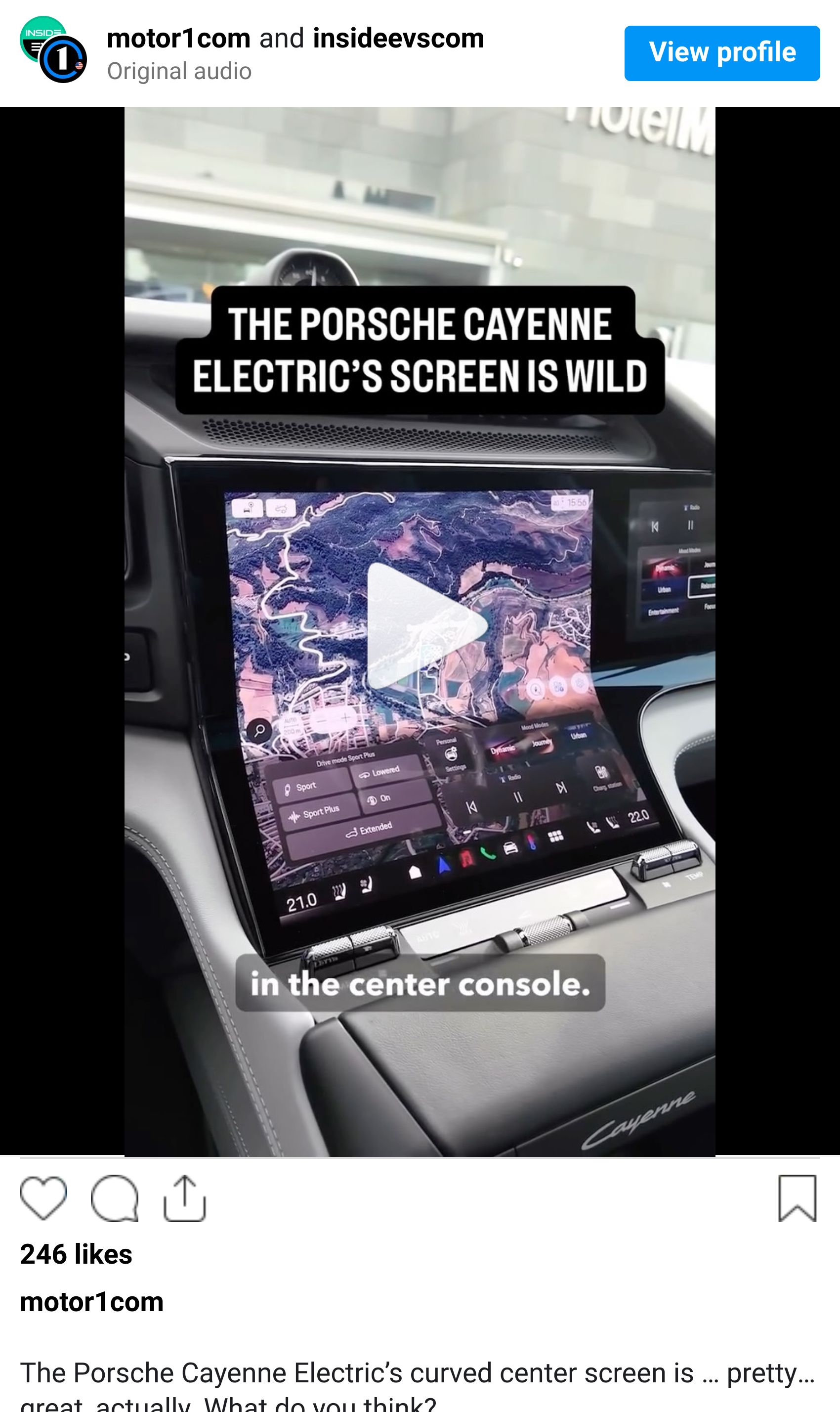
It’s easy to roll your eyes at car companies who jam their EVs with more screens for seemingly no reason. I still don’t get the point of a passenger display, when everyone would much rather just use the screen in their pocket instead.
At the same time, I love seeing automakers pull off new and interesting screen concepts. And according to Maddox, Porsche managed to stick the landing with the Cayenne’s wild, creased screen. Take a closer look below:
Thanks for reading Critical Materials. See you next week!
-Tim Levin
If you love the InsideEVs newsletter, you need to check out the rest of the newsletters across the Motorsport Network:
The Update from InsideEVs: A newsletter to inform and empower a new generation of drivers about the high-tech, zero-emission transformation of the car industry. (Join now)
Motor1: The best car reviews, buying advice and enthusiast stories. (Join now)
For the racing fan: The daily Autosport Debrief delivers the best of Autosport to your inbox daily. (Join now)