In partnership with


Happy Friday, and welcome to Critical Materials, your source for the biggest stories shaping the future of the auto industry.
Every Friday, we break down the week’s biggest EV news, keep you up to speed on the cars we’re testing, and recap must-read stories from around the web on driverless cars, batteries, charging, and more.
– Today’s email was written by Mack Hogan, Rob Stumpf, Tim Levin, and Suvrat Kothari

Plug In: Even Hyundais Are Better In China
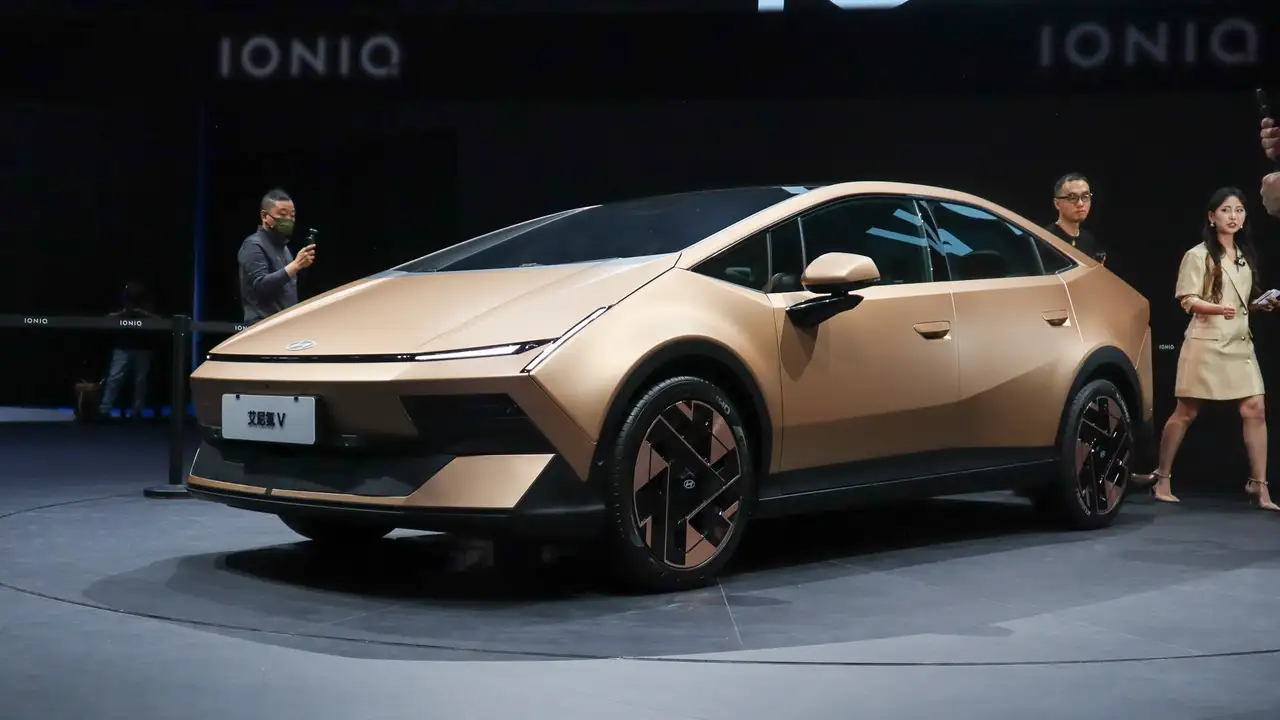
Photo: Kevin Williams
Yesterday was the first day of the press preview of the Beijing Auto Show, one of the flagship events of China’s ascendant auto industry. Already, we’ve seen a variety of big-name reveals from major Chinese players, including a new Geely robotaxi concept and the new BYD Sealion 08. But there’s one reveal I can’t get out of my mind: The new Hyundai Ioniq V.
It may be the Roman-numeral equivalent of our Ioniq 5. But it’s nothing like the relatively tame electric crossover we get here. It is an entirely different type of car.
The biggest departure is the design, which is simply stunning. Looking like a second draft of the dead-before-arrival Honda 0 Series Saloon, the fastback Ioniq V truly captures the drama of a concept car. But it isn’t one. It’s a real production car, just not for the West.
Instead, the special gets a lot of goodies exclusive to China. There’s an ultra-crisp, 27-inch 4K display in the center, a head-up display, Dolby Atmos support, an AI assistant, and an advanced driver assistance system (ADAS) stack developed specifically for China with a local partner. Range will exceed 600 kilometers (372 miles) on the highly optimistic CLTC cycle. That’s all we know for now, but it sounds pretty good.
Will it be enough?
Astoundingly, it’s not clear. In the West, a compelling design paired with decent specs would be a slam dunk. But Hyundai, like every other foreign automaker, is struggling in China. The country’s buyers largely see the brand as behind the times. When you look at the software in a U.S.-spec Ioniq 5 versus something like a Xiaomi SU7, it’s not hard to see why.
The V is Hyundai’s warning shot in China, though. CEO Jose Munoz says the company plans to launch 20 new models over the next five years, with another new SUV to come in 2026. If it looks anything like the V, I’m sure to be jealous.
I am already. Not only are Chinese brands innovating faster than Western marques, but even the Western offerings in the country seem to have eclipsed what they sell in their home markets. Want a BMW i3 with a bigger back seat, more range, and common-sense door handles? Head to China.
There’s good news, though. While many Western-branded China-only cars are built with local partners, the learnings should still flow up. Hyundai can try, fail, and adapt its software-defined vehicle strategy in China, so that when it launches in Western markets, it’s already learned tough lessons. Hopefully, a bit of the “China speed” will rub off, too, and they can get designs like these to the U.S. sooner, rather than later.
We may be patient, but patience has a limit. Most U.S. consumers likely don’t yet realize that they’re missing out on cooler designs from brands they already know. But once buyers, dealers, and critics recognize that their best options aren’t on the menu in their market, they may sour on the brand entirely.
-Mack Hogan
“AI is Going to Fundamentally Change…Everything”

That’s what NVIDIA CEO Jensen Huang just said about the AI boom, even calling it “the largest infrastructure buildout in human history.”
NVIDIA’s chips made this real-time revolution possible, but now it’s collaborating with Miso to unlock amazing new advances in robotics.
Already a first-mover in the $1T fast-food industry, Miso’s AI-powered Flippy Fry Station robots have worked 200K+ hours for leading brands like White Castle, just surpassing 5M+ baskets of fried food.
And this latest NVIDIA collaboration unlocks up to 35% faster performance for Miso’s robots, which can cook perfect fried foods 24/7. In an industry experiencing 144% labor turnover, where speed is key, those gains can be game-changing.
There are 100K+ US fast-food locations in desperate need, a $4B/year revenue opportunity for Miso. And you can invest alongside Ecolab and become a Miso shareholder today. Even better, you can unlock free additional bonus stock for a limited time. Become a Miso investor today.
This is a paid advertisement for Miso Robotics’ Regulation A offering. Please read the offering circular at invest.misorobotics.com.

Get Fully Charged
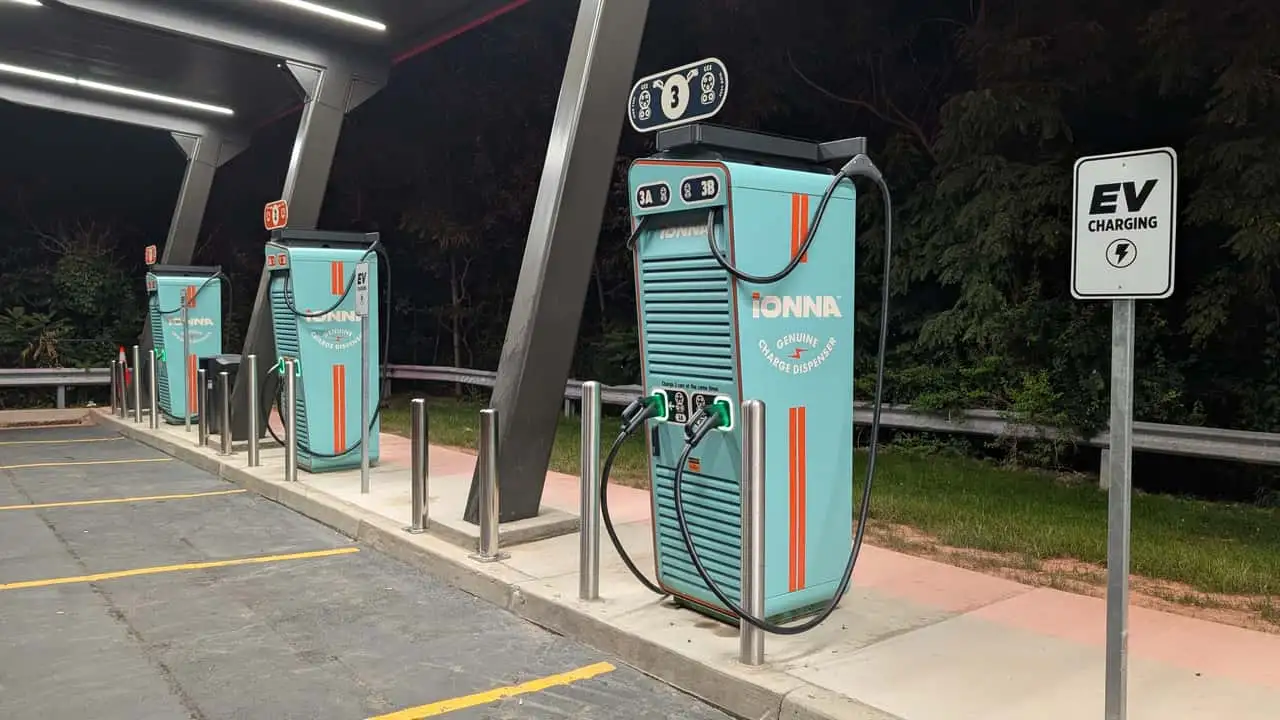
Photo: Suvrat Kothari
Get up to speed on the news that caught our eye this week:
The U.S. added a whopping 3,000 EV fast chargers last quarter. Despite new EV sales dipping since federal incentives ended in 2025 (especially compared to Europe), companies are still working to bolster charging infrastructure for the next electric boom.
And to help fix those chargers when they break, New York is building a workforce training program to help ensure the infrastructure remains reliable.
Nissan says that its first EV powered by solid-state batteries is on track for release in 2028. It hasn't confirmed any specs on charging time or range, but the brand has been committed to investing in solid-state tech, even opening a pilot line at its Yokohama plant last year dedicated to it.
Rivian R2 production is officially underway. Customer deliveries are slated to begin this spring, and early reservation holders will begin to receive their invitations to customize their car in June.
Tesla is ramping up efforts to go global with Full Self-Driving after officially launching the software in Europe. It now has job listings for vehicle operators in 9 different countries, giving us a pretty good idea of where the company wants to go next.
Speaking of FSD, Elon Musk has admitted that millions of cars equipped with Tesla's last-generation Autopilot hardware will not be able to achieve Full Self-Driving. Tesla plans to build "micro factories" to retrofit just some of these cars.
Despite Chinese EVs not being available in many countries, its automakers are turning to social media influencers to convince buyers—specifically, American ones—that they are missing out on Chinese EVs.
China has entered a "brutal knockout stage" in the EV industry. The country's price war is getting worse, and new discounts from top automakers like BYD show how much pricing pressure and overcapacity are weighing on its industry.
-Rob Stumpf

One More Thing: Hello From Woven City

Photo: Tim Levin
Hello from Tokyo! I’ve been in Japan this week checking out and learning about Woven City, Toyota’s “proving ground for mobility.” The city opened last fall, and I was among the first non-Japanese media to take a peek behind the curtain.
The trip has been interesting and a bit unexpected, and I’ll write more about my experience for InsideEVs soon. For now, I wanted to share a few cool mobility-related projects I saw.
Situated at the base of Mount Fuji on the site of a former Toyota plant, Woven City is part idea incubator and part testing facility. Daisuke Toyoda, the head of Woven City and son of Akio Toyoda, said this week that it’s a critical component in Toyota’s transformation from a car company into a mobility company.

So far, things are just getting started. Half a year in, the city has 100 residents, just a few streets, and far more ideas than actual projects underway. But I did catch a glimpse of some interesting stuff.
One example is Guide Mobi. This three-wheeled autonomous robot may make deliveries someday. But there are lots of companies attacking that space. The interesting bit is that the team behind Guide Mobi is also working on wireless towing, wherein the bot can sync up with a car and guide it around at low speeds.

In Woven City, Toyota is testing a car-share service based on this technology. Residents can order a Toyota bZ and have it delivered via Guide Mobi to a handful of designated curbside spots. Does it work perfectly smoothly? Not quite. In the demo we watched, the bZ being towed about six feet behind the robot (with a safety driver inside) hit the brakes every few feet as it exited a parking structure. Still, I think this is a neat concept. And the idea of giving regular cars temporary self-driving capability could make sense as a kind of robo-valet. It would probably work for other applications, too.
Toyota also has a virtual power plant on site in the form of a parking garage packed with EVs. City-owned vehicles park there, plug in, and help manage the city’s energy needs by trickling in power from their batteries. Company representatives say the installation cuts the city’s peak power needs by 5-10%, and Toyota envisions this model being replicated at factories. We’ve heard a lot about vehicle-to-grid programs for years. But doing this via a municipal parking lot seems like it would be easier to manage than coordinating charging across hundreds of personal vehicles in hundreds of driveways.
Probably the most intriguing thing about Woven City to me is the street infrastructure. Each intersection has several cameras, and the poles have rails for attaching additional devices for future experiments. The cameras feed into a newly announced Woven City AI Vision Engine, which allows Toyota to test, for example, systems that warn drivers of pedestrians entering an upcoming crosswalk.
Ultimately, Woven by Toyota CTO John Absmeier told me, the automaker believes this kind of connectivity between vehicles and infrastructure will be necessary for making autonomous vehicles as safe as possible on a large scale. As in, tens of millions of vehicles someday—not a few thousand robotaxis in a handful of cities. But can this model be replicated in real-world urban areas with differing regulations and citizens not employed by Toyota? If the testing in Woven City goes well, Toyota may need to figure that out next.
-Tim Levin

Driver’s Seat: 2026 Toyota Rav4

Photo: Suvrat Kothari
The 2026 Toyota RAV4 is the best hybrid I’ve driven, period. America’s best-selling SUV now feels like a default answer to the question: “What should I buy?” In its sixth generation, the RAV4 is now a fully electrified nameplate, offered exclusively as a hybrid or a plug-in hybrid. And after a week with the standard hybrid, I’m convinced most buyers won’t feel the need to step up to the PHEV.
Sure, there’s nothing new in the fact that Toyota hybrids are efficient. But when I observed 56 miles per gallon on the gauge cluster, and nearly 600 miles of calculated range on a full tank of fuel, I was stunned. Admittedly, that mpg figure was during a morning commute in New York City at slow city speeds, where it kept recuperating energy from braking to mostly drive in EV mode. But even its combined city and highway fuel economy was phenomenal. I rarely ever saw that number drop below 40 mpg.
And that’s not even the best part. The fact that it’s such a good car in all other areas is what truly makes it stand out. It is now bigger and roomier than its predecessor, and looks modern inside and out. The screens are no longer laggy and slow to boot. The focus on ergonomics is immaculate. In an age of hyper-minimalism, it’s rare to come across a vehicle where everything is where it needs to be. All vehicle functions are easy to access, with no mental gymnastics required to find a particular setting.
With gas prices surging due to the war in Iran, the RAV4 feels timely and sensible. The bigger question in my head is: If Toyota can make a hybrid this good, why can’t it put the same amount of effort into developing an equally compelling, no-compromises fully electric SUV?
-Suvrat Kothari
Before You Go
What’s it like to drive an original BMW i3 Range Extender (REx) for 100,000 miles? Thanks to Andre from TFL, we have our answer.
The entire thing is worth a watch to round out your Friday. But the gist fits with what I’ve heard from multiple other i3 owners I know: These things are delightful, even if they have their quirks. As with most EVs, it’s the people on the sidelines who hate. Once you own one, you usually love it.
Thanks for reading Critical Materials. See you next week!
-Mack Hogan
If you love the InsideEVs newsletter, you need to check out the rest of the newsletters across the Motorsport Network:
The Update from InsideEVs: A newsletter to inform and empower a new generation of drivers about the high-tech, zero-emission transformation of the car industry. (Join now)
Motor1: The best car reviews, buying advice and enthusiast stories. (Join now)
For the racing fan: The daily Autosport Debrief delivers the best of Autosport to your inbox daily. (Join now)